


Navigating MUD, PID, and Property Taxes: What San Antonio New-Home Buyers Must Know


Shopping for a new construction home in the Greater San Antonio area is an exciting milestone. From modern single-story floor plans to spacious acreage-style lots, building or buying new gives you energy efficiency, fresh design finishes, and peace of mind. However, when comparing neighborhoods across Bexar, Medina, Comal, or Guadalupe counties, many buyers notice something unexpected on their tax breakdown: MUDs and PIDs.
If you’ve come across these acronyms while touring model homes, you aren’t alone. Understanding how Municipal Utility Districts (MUDs) and Public Improvement Districts (PIDs) work—and how they impact your total monthly payment—is one of the most vital steps in buying a new home in Texas.
Here is a clear, buyer-first breakdown of what MUDs and PIDs are, how they differ, and what you need to verify before closing on your new home.
What Are MUDs and PIDs?
When master-planned communities or new subdivisions are built outside established city utility lines, local developers need a way to fund essential infrastructure like water lines, sewer systems, paved roads, and drainage.
Rather than wrapping hundreds of thousands of dollars of infrastructure costs into the upfront sticker price of the home, Texas law allows developers to create special districts to finance these public improvements over time.
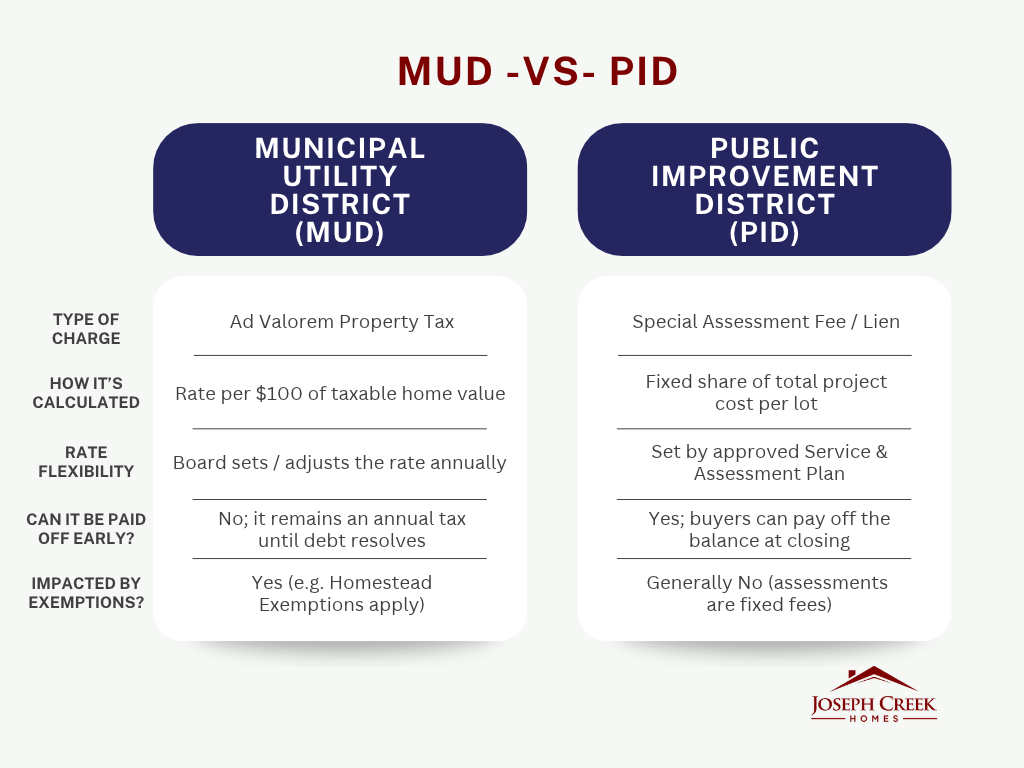
- MUD (Municipal Utility District): A political subdivision authorized by the Texas Commission on Environmental Quality (TCEQ) to issue bonds for water, wastewater, stormwater drainage, and park infrastructure. Homeowners repay these bonds through an annual ad valorem property tax rate applied per $100 of taxable assessed value.
- PID (Public Improvement District): A specific geographical area created by a city or county city council to fund specific public improvements (such as roads, sidewalks, landscaping, trails, or lighting). Homeowners pay a special assessment apportioned to their lot, usually split into annual installments.
Side-by-Side Comparison: MUD vs. PID
Understanding how these fees are calculated helps you anticipate how they behave over time:
How MUDs and PIDs Affect Your Monthly Escrow
When you apply for a mortgage, lenders do not look at your purchase price in isolation—they calculate your total PITI (Principal, Interest, Taxes, and Insurance). Because property taxes and special assessments are escrowed into your monthly mortgage payment, a higher tax rate directly alters your qualifying borrowing power.
A Quick Mathematical Example:
Assume you are purchasing a home with an assessed taxable value of $400,000:
- Standard Property Taxes (No District): Base tax rate of ~1.95% = $7,800/year ($650/month).
- Community with a MUD (0.80% MUD Rate): Base rate (1.95%) + MUD rate (0.80%) = 2.75% total tax rate.
- Total Tax: $11,000/year ($916.67/month) — an additional $266.67/month.
- Community with a PID ($1,800 Annual Installment): Base taxes ($7,800) + PID Assessment ($1,800).
- Total Charge: $9,600/year ($800/month) — an additional $150/month.
Pro Tip for Buyers: Always compare total effective tax rates, not just purchase prices. A $420,000 home in a subdivision without a MUD/PID may yield a lower monthly payment than a $400,000 home located inside a high-rate special district.
The "Year-One Tax Trap" on New Construction
One of the most common pitfalls for new construction buyers in Greater San Antonio involves first-year property tax assessments.
In Texas, appraisal districts value real estate as of January 1st of each tax year. If your home was under construction on January 1st, the county may only assess taxes based on the unimproved land value or a partially finished structure.
- The Trap: Your mortgage lender’s initial escrow setup might accidentally calculate year-one payments using that artificially low unimproved assessment.
- The Result: When the appraisal district updates the home to 100% completed value in year two, your tax bill jumps significantly. If your escrow account wasn't prepared, you could face a sudden monthly increase plus a catch-up payment for the escrow shortage.
How to Protect Yourself: Work closely with your builder sales representative and lender to set up your escrow account based on the estimated fully assessed value of the completed home.
What Texas Law Requires Sellers and Builders to Disclose
You should never be surprised by a MUD tax or PID assessment at the closing table. Texas consumer protection laws mandate strict disclosures:
- MUD Disclosures (Texas Water Code § 49.452): Sellers or builders must provide a signed Notice to Purchaser disclosing the district name, current tax rate, and outstanding bond debt before executing a binding contract.
- PID Disclosures (Texas Property Code § 5.014): Sellers must deliver written statutory notice regarding the PID assessment obligation prior to contract execution.
Your Due Diligence Checklist Before Signing
Before putting down earnest money on a new build, run through these quick steps:
- [ ] Verify the Tax Units: Request a full tax breakdown for the specific lot from the Central Appraisal District (e.g., Bexar CAD, Medina CAD, or Comal CAD).
- [ ] Ask About Payoff Options: If the property sits in a PID, ask your title company or the builder if the assessment balance can be paid upfront or negotiated into incentive options.
- [ ] Calculate the All-In Monthly Payment: Combine principal, interest, standard property taxes, MUD/PID obligations, home insurance, and HOA dues.
- [ ] Review District Growth Plans: MUD rates can decline over time as more homes are added to the district's overall tax base to share the bond debt repayment.
Complete Transparency with Joseph Creek Homes
At Joseph Creek Homes, we believe home buying should be clear, exciting, and straightforward. Whether you are exploring our communities across Castroville, Schertz, Floresville, or Mico, our team is dedicated to giving you complete clarity on lot selection, floor plan features, and true ownership costs.
Have questions about building in Medina County or Greater San Antonio? Reach out to our sales team today to explore our available inventory and floor plans!

